My approach to writing Anthromorphic characters & cultures, what do you think?
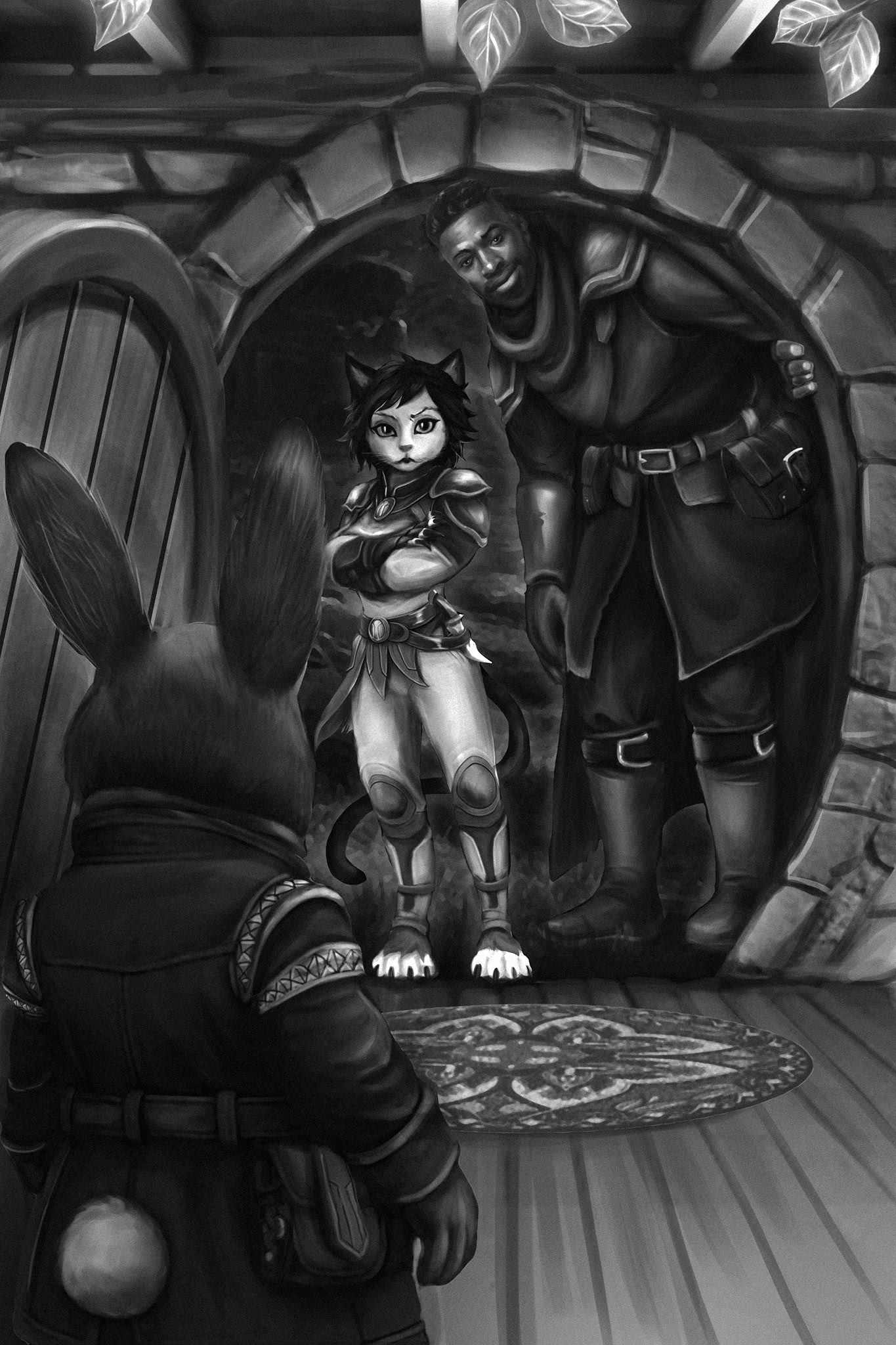
Babax Merrifur meets Desrael and Lilly - Art by: Huynh Thy
In the realm of fantasy writing, there is a trap that is all too easy to fall into: the “Human in a Fur Suit” syndrome. We’ve all seen it. It’s when a fantasy race looks like a wolf, or a rabbit, or a lizard, but acts exactly like a medieval European human. They live in human houses, fight with human tactics, and have human social anxieties.
When I began developing The Sagas of Vaelora, I knew I wanted to avoid that. My world is a melting pot of anthropomorphic races—from the rabbit-folk Lopari to the steadfast Borvann (The bearfolk)—living alongside humans. To make them feel authentic, I had to ask a fundamental question:
How does biology dictate culture?
I’ve been drawing heavy inspiration from real-world human cultures (like Norse or Rus traditions for some of my northern factions and Yoruba or Igbo influences for others), but the secret sauce has been studying the actual animals.
Here is how I approached building the culture of the Lopari, and how you can apply the “Biology First” method to your own worldbuilding.
1. Habitat Becomes Architecture
In the real world, rabbits burrow. It is their primary defense mechanism and their shelter. If you evolve a rabbit into a sapient, tool-using being, they aren’t suddenly going to decide that living in a wooden shack above ground makes sense. They are going to double down on what makes them feel safe.
In Vaelora, this biological imperative evolved into the United Burrowlands. The Burrowfolk didn’t just dig holes; they became master engineers of subterranean architecture.
Take Fleetfoot Hollow, the ancestral home of the Merrifur family. It isn’t a dark, dirt tunnel. It is a feat of “underground elegance” with vaulted stone ceilings and honey-toned burrow-wood furnishings. Because they live underground, they had to invent specific technologies to make it livable, such as:
Verdant Lamps: Magical lighting that mimics the golden glow of dawn, crucial for maintaining circadian rhythms in a city without a sky.
Ventilation Engineering: Engineered shafts that bring fresh air deep into the earth, allowing for complex cooking and industry without suffocation.
The Lesson: Don’t just give your fantasy race a “style” of building. Ask what their instincts tell them a “safe home” looks like, then advance that instinct with technology.
2. Prey Instincts Dictate Military Doctrine
A rabbit cannot out-muscle a bear. In Vaelora, a Lopari cannot match the brute strength of a Borvann (bear-folk) or the aerial superiority of an Aeryn (bird-folk). If the Lopari tried to fight like human knights in heavy plate mail, they would be extinct.
So, their culture developed a martial philosophy based on their biological advantages: speed, hearing, and evasion.
When Jim Merrifur trains his son Babax, he explicitly deconstructs the “human” way of fighting. He tells him: “You’re fighting like a human... someone who thinks they can match strength for strength... Speed is our shield, and precision is our sword” (From: The Burrow and the Blade).
This biological reality ripples out into their entire society:
The Swiftwhiskers: Their cavalry rides deer-hare hybrids, favoring speed and agility over shock-and-awe impact.
Hyper-Awareness: Their large ears aren’t just aesthetic; they are tactical. A Lopari culture would value information, listening, and alertness over brash displays of force.
The Lesson: Your race’s physical limitations are just as important as their strengths. How have they adapted their weapons and tactics to survive?
3. Biology Shapes Language and Social cues
Finally, I looked at how animals communicate. Humans smile to show friendliness, but for many animals, baring teeth is a threat.
In Vaelora, I applied this heavily to the Thornkin (hedgehog-folk). They are naturally solitary and defensive. Their “language” isn’t just verbal; it is physical. They use a complex “Spine Display Language” where fully erected spines signal a maximum threat, while flat spines signal trust and intimacy.
For the Lopari, ears are key. A twitch can signal amusement, nervousness, or alertness. When Jim Merrifur is concerned, his ears don’t just sit there; they react to the tension in the room. This adds a layer of non-verbal subtext to every scene that is unique to their species.
The Challenge
Balancing these animalistic traits with the complexity of human sociology (trade guilds, treaties, religious schisms) is difficult. You have to find the sweet spot where a character feels relatable enough to have human emotions, but alien enough to remind the reader they are not human.
But when it clicks—when you have a rabbit-folk merchant using evasion tactics to negotiate a trade deal, or a hedgehog-warrior using silence as a weapon—the world comes alive.
I’d love to hear from you: How are you handling the “Instinct vs. Civilization” balance in your worlds? Have you created a culture based entirely on a biological trait?