A different sort of launch team - The Homeschooler's Guide to Book Publishing
* 2025 Update *
Just wanted to give this bump to let anyone who’s interested know that this course is officially running again this year, updated and revised on an official online platform through my publisher’s website. If anyone wants more info they can find it HERE. Registration is only open for the month of April 2025 and the course runs May 5 - June 28, 2025. 🙂
***End of update***
Hi all,
Just wanted to share my experience with a marketing experiment that I conducted with the launch of my debut middle grade novel Wingless this year.
After taking the Book Launch Blueprint course for two years in a row, the thought of creating and maintaining a normal launch team felt daunting to me. But I was struck by a different idea that I really wanted to try—creating a course for homeschoolers all about the publishing process, and using the students of that course to be my launch team for my upcoming middle grade novel.
I had zero guarantees on whether this would work. And it definitely was NOT less work than just running an ordinary launch team would have been. But it was something I was excited about, so I decided to take the risk and channel that excitement to my advantage. I’m wrapping up the final week of the course this week, and looking back, I’m happy I decided to take this approach. It was a lot of fun, and I definitely will be doing it again next year for the launch of book 2!
Because I’ve had a number of people here express interest in this course idea, I wanted to write up a summary for you of how I put the course together and how it all worked.
Part 1: The Course
As a little background on this, I myself grew up homeschooled, so I’m very familiar with homeschooling circles and what types of activities and courses can appeal to families in that world. This gave me a leg-up of sorts. On top of that, my publisher (Chicken Scratch Books) mainly markets to homeschooling families by travelling around the country to the various homeschooling conventions, and creating novel study courses for homeschoolers for each book they publish.
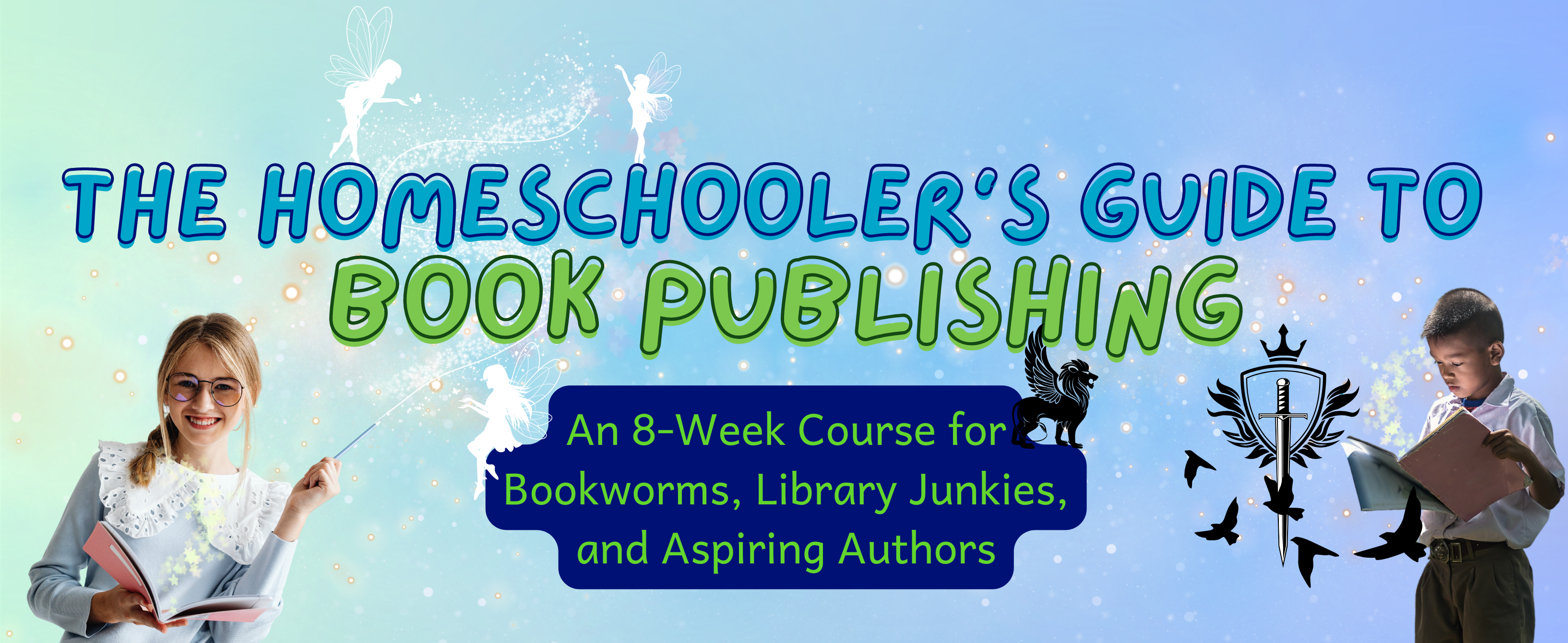
I marketed my course as an 8-Week email-based course for homeschoolers aged 10 and up that would teach them about the publishing process, introduce them to jobs within the publishing industry, and allow them to participate hands-on in the launching of a real middle grade fantasy novel. My main platforms for marketing were via my publisher’s emailing list, a couple of my own contacts in the local homeschooling community, and a ton of homeschooling FB groups.
My publisher cooperated by giving course participants access to buy my book 1 month before preorders officially opened, meaning they could get their hands on the book 2 months before the general public (another perk I was able to market). The course itself I offered as a freebie along with the cost of purchasing the novel (plus shipping, if they went with a physical copy). This meant guaranteed sales of my book for as many families decided to participate.
Because I didn’t know how much work it would be to run it, I decided to limit participation to 50 families. This also allowed me to include the scarcity/urgency tactic in my marketing of this course. Registration opened Feb 1st and was open for the entire month. During that time, the course completely filled up (I actually even had to turn a few late-comers away because I couldn’t get a book to them after the preorders officially opened in March). The course itself ran from March 4th to April 27th. My novel, Wingless, officially launched on April 1st. I decided to have the course straddle my launch to give students time to read my novel prior to marketing it, as well as train them on book marketing skills in advance.
I used my author website and created pages for the course (unlisted, so only course participants can view them via the links in the weekly email I sent out). Each week contained 3 main sections: The Publishing Journey, the Job Highlight, and Book Launching 101. These sections I typed up as separate PDF documents (using Canva to add fun graphics), which I made downloadable from the website page and could be read through at whatever pace families preferred during the week.
As part of the Book Launching 101 for each week, I included a list of homework assignments that students could pick and choose from. I created downloadable homework trackers (again using Canva) that students could use to track their completed assignments, and if they met the “minimum point goal” for the week, I would send them the “incentive prize” for that week (a poster featuring exclusive character artwork I had commissioned for my book). At the end of each week, they hit reply on their weekly email and send me a copy of their homework tracker so I can confirm what they’ve done.
I kept track of the returned trackers via Google Sheets. This allowed me to record information for each student like their geographic location, age, and whether they had met their minimum point goals or not. This also gave me an “at a glance” view of how many students were actively participating each week.
In order to keep students engaged throughout the course, I also offered a special “end of course prize” that could be earned by submitting all the homework trackers for the course, regardless of whether they succeeded in earning the minimum point goals or not. As long as they submit every tracker back to me, they earn that grand prize (even if they did none of the assigned homework). This prize is a bundle of the audiobook (which I narrated and self-published at almost no cost to myself, so I don’t mind giving it away), as well as some other digital goodies like colouring sheets. I also left this grand prize as a mystery, so the kids don’t know what it is.
The “homework assignments” are all activities geared toward book launching, so they aren’t something I have to grade. Because not all homeschooling families are comfortable with online-based assignments, I tried to include a mix of online and offline assignments for students to try. Offline assignments included putting up posters, telling friends and family about the book, handing out flyers, drawing fanart (and sending it to me for display on my website), suggesting the book to their book club, requesting it at libraries, etc. Online activities included leaving written reviews on multiple sites, creating video reviews/book trailers, posting on social media, adding to their goodreads list, emailing people about the book, etc.
I created all of the graphics and printable supplies (like posters/flyers) myself using Canva and made them available for download from the weekly website pages.
Part 2: The Outcome
Now, all of the above sounds nice in theory. But how did it work in practice?
Out of the 50 families who signed up and bought the book, 18 actively participated for a decent chunk of the course, and 9 continued actively participating all the way to the end. This may not sound like much, but I’m actually very happy with these numbers. Homeschooled students are very often “keeners” so when they actively participate in something, they go above and beyond. Those 9 students that stuck it out to the end (many of which even earned the incentive prizes for every single week) were hard core launch team members that went above and beyond for my launch. As any author who’s run a launch team before knows, those sorts of team members are hard to come by.
Now, one area in which I didn’t take Thomas’s advice, is that I didn’t push sales to Amazon during my launch. This is because my publisher tries very hard to push people to their website for sales, as they do a traditional print run and so both they and the author make a lot more off of copies sold from their website versus from somewhere like Amazon. The upside of this is that homeschoolers don’t like Amazon anyway, so they are very happy to oblige. The downside is that I don’t have access to live sales data in the same way I would if everything was going through Amazon, so I’ll have to wait for the quarterly report from my publisher later this summer to get solid data on how many copies I’ve sold via pre-orders and the first month after launch.
That said, while I don’t have sales data, I do have online reviews. Here is what the review status of my book is 3 weeks post-launch (from the places I’ve been keeping track, anyway):
Chicken Scratch Website: 15 reviews (4-5 stars)
Goodreads: 17 reviews, 21 ratings (4.76 star average)
Amazon.com: 7 reviews (4.8 star average)
Amazon.ca: 3 reviews (5 star average)
Barnes & Nobles: 8 reviews (4.8 star average)
Chapters Indigo : 7 reviews (4.9 star average)
Moving forward, I’ll be continuing to promote/sell my book at in-person events like homeschool conferences. I’ve already attended one conference back in March which was wildly successful (I sold out of all the copies I brought of my own book).
I plan to run this course again next year (with some tweaks based on what I learned this year) for the launch of the sequel, which is under contract for June 2025. Thanks to Thomas’s advice, I’ve decided I’ll be using the course to market book 1 again, though if I have students from this year who want to retake it, I’ll probably give them access to book 2 and let them promote that if they like. But I suspect I’ll mainly have a new crop of students for next year’s course. And promoting book 1 will inevitably lead to promoting book 2 (at least if how many kids are clamouring for a sequel at the moment is any indication).
Thanks for sticking with me through this lengthy summary! If anyone has any questions, I’d be happy to elaborate further. 😊 And thanks to Jim and Thomas for creating the BLB course! Without that, I never would have had the nerve or the know-how to try my hand at this idea.