Spotify’s Audiobooks+ vs. Audible’s New Royalty Model: What Authors Need to Know
I generated this report to test ChatGPT5.
The audiobook market is in the middle of a format war — and authors are caught in the crossfire. With Spotify rolling out its new Audiobooks+ program and Audible overhauling its royalty system, both indie and traditionally published authors have a lot to consider when deciding where — and how — to distribute their work.
This post breaks down what Audiobooks+ is, how it works, how it compares to Audible’s
Spotify’s Audiobooks+: A Streaming-Style Shift for Books
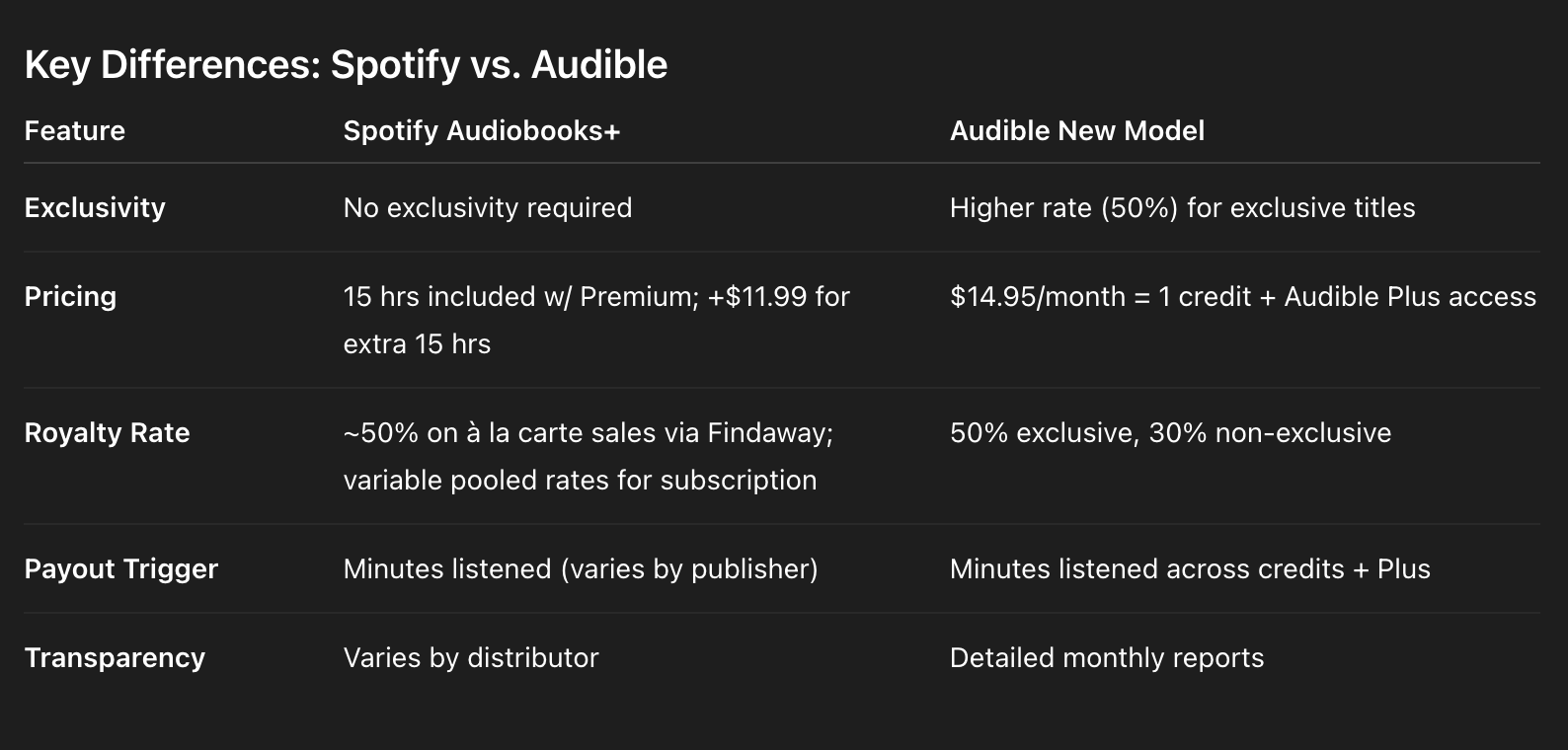
Spotify launched Audiobooks+ after testing in several international markets. In the U.S., Premium subscribers now get 15 hours of audiobook listening each month included in their plan. For an additional $11.99/month, the add-on Audiobooks+ doubles that allotment to 30 hours.
The service offers access to over 400,000 titles — integrated right into the Spotify app alongside music and podcasts. Hours reset monthly and don’t roll over, but users can purchase extra listening time if they run out.
For families, Spotify recently rolled out a plan add-on giving each member their own 15-hour allowance — solving one of the early complaints about the service.
How Spotify Pays Authors
Spotify’s payout terms vary based on whether you’re a large publisher, small press, or indie author:
Large publishers often negotiated per-title payments triggered when a listener hits a set percentage (e.g., 20% listened, or in some cases 100% for higher payouts).
Indie authors distributing through Findaway Voices generally get 50% of the sale price for à la carte purchases. For Audiobooks+ listens, they’re paid from a pooled revenue model based on minutes consumed.
Spotify dropped its 20% Findaway distribution fee in 2024, making it more competitive with Audible on sales — but streaming payouts can still be unpredictable.
The Authors Guild has warned that unlimited or pooled listening models risk devaluing books, drawing parallels to the way music streaming upended artist incomes.
Audible’s Mid-2024 Royalty Overhaul
In July 2024, Audible announced it was raising author royalties:
Exclusives: from 40% to 50% of sales
Non-exclusives: from 25% to 30% of sales
More importantly, Audible shifted to a hybrid model. Now, subscription revenue (from both Premium Plus and Audible Plus) is pooled and divided based on listening time — meaning authors get paid for hours listened, even in the previously unpaid Plus catalog.
Audible also promises more transparent reporting with detailed engagement data, letting authors see exactly how listening time translates to royalties.
Key Differences: Spotify vs. Audible
What This Means for Authors
For indie authors, Spotify offers discoverability in a huge ecosystem with no exclusivity strings. The trade-off: per-listen payouts may be lower than a single Audible sale, especially for long books.
For traditionally published authors, the impact depends on your publisher’s deal. If they negotiated high per-title payouts, Spotify could be a solid new revenue stream — but you’ll still only see your contracted share (often 25% of net).
The Bottom Line
Spotify’s Audiobooks+ is shaking up a market Audible has dominated for over a decade. Competition has already led Audible to raise rates and improve transparency — wins for authors.
But the shift to streaming-style payouts is a double-edged sword. It can expand your audience and drive volume, but it also risks lowering per-unit value. As this space evolves, authors should:
Run the numbers for both models
Diversify distribution where possible
Monitor royalty statements closely
The real story will be told over the next year as authors start to see whether these changes mean more money in their pockets — or just a different way to slice the same pie.